Callbacks
Callbacks are server-side Python functions that fire at specific points in the conversation lifecycle. They let you inspect and modify requests and responses before the model sees them, inject dynamic content into instructions, preempt the model entirely with a pre-computed response, and maintain session state across turns.
Used well, callbacks let you build more capable agents without inflating instruction length. Used carelessly, they introduce subtle bugs — particularly the turn-guard omission, described below.
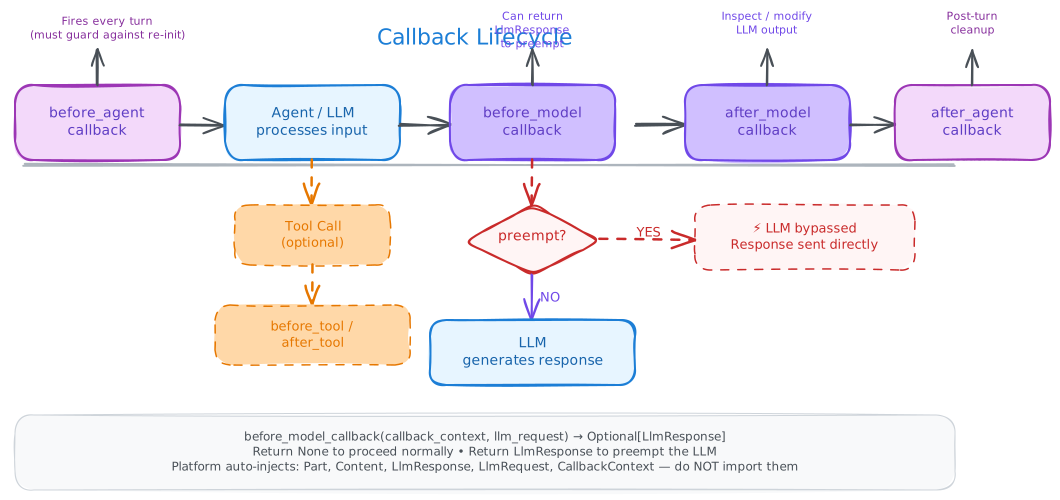
The four callback types
| Callback | When it fires | Primary use |
|---|---|---|
before_agent_callback | At the start of every turn, before any model call | State initialization, silence detection, dynamic prompting |
after_agent_callback | After the agent generates a response, before it's sent to the user | Response transformation, logging, state cleanup |
before_model_callback | Before the model is called — can preempt the model entirely | DAG/slot-filling logic, returning a deterministic response |
after_model_callback | After the model responds, before tool calls are executed | Inspecting or modifying model output |
Callback signatures
The platform makes several types available as globals — you do not import them:
# Available as platform globals (no import needed):
# Part, Content, LlmResponse, LlmRequest, CallbackContext

def before_agent_callback(
    callback_context: CallbackContext,
) -> Content | None:
    """Return Content to override the agent response; return None to proceed normally."""
    ...

def after_agent_callback(
    callback_context: CallbackContext,
    response: Content,
) -> Content | None:
    """Return modified Content or None to pass the original response through."""
    ...

def before_model_callback(
    callback_context: CallbackContext,
    llm_request: LlmRequest,
) -> LlmResponse | None:
    """Return LlmResponse to preempt the model; return None to proceed normally."""
    ...

def after_model_callback(
    callback_context: CallbackContext,
    llm_response: LlmResponse,
) -> LlmResponse | None:
    """Return modified LlmResponse or None to pass the original through."""
    ...
Critical: the turn guard
before_agent_callback fires on every turn — including turns in the middle of an ongoing conversation. This is the most important thing to understand about callbacks.
If you write initialization logic in before_agent_callback without a guard, it will re-run on every turn and overwrite state that the agent built up during the conversation.
Always add an early-return guard:
def before_agent_callback(callback_context: CallbackContext) -> Content | None:
    state = callback_context.state

    # Guard: only run initialization logic on the first turn
    if state.get("_initialized") == "true":
        return None  # Not the first turn — skip initialization

    # First-turn initialization
    state["_initialized"] = "true"
    state["reservation_context"] = "{}"
    state["_conversation_stage"] = "greeting"

    return None  # Proceed normally
Missing the turn guard is a common bug
A callback without a turn guard will reset session state on every user message. The agent will appear to "forget" everything from previous turns. This is one of the most frequent bugs in production callback implementations. Always add the guard.
State initialization pattern
The first-turn guard is also the right place to initialize session state with values derived from the incoming request — user metadata, session context, or configuration that should be available throughout the conversation.
def before_agent_callback(callback_context: CallbackContext) -> Content | None:
    state = callback_context.state

    if state.get("_initialized") == "true":
        return None

    state["_initialized"] = "true"

    # Initialize reservation context with empty state
    import json
    state["reservation_context"] = json.dumps({
        "date": None,
        "time": None,
        "party_size": None,
        "guest_name": None,
        "confirmation_number": None,
        "modification_count": 0
    })

    # Capture any user metadata passed in with the session
    user_id = callback_context.session.get_parameter("user_id", "")
    if user_id:
        state["user_id"] = user_id

    return None
Session start detection
Detect the first turn to trigger a specific greeting or initial action:
def before_agent_callback(callback_context: CallbackContext) -> Content | None:
    state = callback_context.state

    if state.get("_session_started") == "true":
        return None

    state["_session_started"] = "true"

    # Return a scripted greeting for the first turn
    return Content(parts=[
        Part.from_text(
            "Welcome to Bella Notte. I can help you make, modify, or cancel a reservation. "
            "What can I do for you today?"
        )
    ])
When before_agent_callback returns a Content object, the platform sends it directly to the user without calling the model. This is how you deliver scripted opening messages or handle cases where calling the model is unnecessary.
Silence and no-input detection
Detect empty or silence-only input and respond without invoking the model:
def before_agent_callback(callback_context: CallbackContext) -> Content | None:
    state = callback_context.state

    # Guard for session init (shown above)
    if state.get("_initialized") != "true":
        state["_initialized"] = "true"
        return None

    # Detect silence or empty input
    user_input = callback_context.user_input_text or ""
    if not user_input.strip():
        silence_count = int(state.get("_silence_count", "0"))
        silence_count += 1
        state["_silence_count"] = str(silence_count)

        if silence_count >= 3:
            return Content(parts=[Part.from_text("I'm going to end this session. Please call us back when you're ready.")])

        return Content(parts=[Part.from_text("I'm sorry, I didn't catch that. Are you still there?")])

    # Clear silence count on valid input
    state["_silence_count"] = "0"
    return None
Dynamic prompting
Dynamic prompting injects context-specific instructions into the agent's system prompt on each turn, rather than keeping a large static instruction set. This keeps the active instruction set small (improving model reliability) while allowing the agent's behavior to adapt based on conversation state.
def before_agent_callback(callback_context: CallbackContext) -> Content | None:
    state = callback_context.state

    if state.get("_initialized") != "true":
        state["_initialized"] = "true"
        state["_conversation_stage"] = "gathering_details"
        return None

    stage = state.get("_conversation_stage", "gathering_details")

    # Inject stage-specific instructions into the system prompt
    if stage == "gathering_details":
        callback_context.agent_instruction_override = """
<current_stage>gathering_details</current_stage>
<active_task>
Collect the four required fields in order: date, time, party_size, guest_name.
Ask for only the next missing field. Do not ask for multiple fields at once.
Once all four are collected, call check_availability.
</active_task>
"""
    elif stage == "confirming_slot":
        callback_context.agent_instruction_override = """
<current_stage>confirming_slot</current_stage>
<active_task>
Present the available slot to the guest and ask for confirmation.
If they confirm, call create_reservation.
If they decline, call get_alternative_slots and offer two options.
</active_task>
"""
    elif stage == "confirmed":
        callback_context.agent_instruction_override = """
<current_stage>confirmed</current_stage>
<active_task>
The reservation is confirmed. Read back the confirmation number and full details.
Offer to help with anything else.
</active_task>
"""

    return None
Progressive disclosure
Dynamic prompting is a form of progressive disclosure: the agent only sees instructions relevant to the current stage of the conversation. This is particularly effective for multi-step flows like reservation creation, where there are 4–6 distinct stages, each with its own rules and actions.
before_model_callback for DAG and slot-filling
before_model_callback fires just before the model is called and can return an LlmResponse to intercept the turn. This is the correct hook for deterministic slot-filling logic — where you want to check whether all required slots are collected and trigger the action deterministically.
def before_model_callback(
    callback_context: CallbackContext,
    llm_request: LlmRequest,
) -> LlmResponse | None:
    import json

    state = callback_context.state
    stage = state.get("_conversation_stage", "gathering_details")

    if stage != "gathering_details":
        return None  # Not in slot-filling stage — let the model handle it

    raw = state.get("reservation_context", "{}")
    try:
        ctx = json.loads(raw)
    except (json.JSONDecodeError, TypeError):
        ctx = {}

    # Check whether all required slots are filled
    required = ["date", "time", "party_size", "guest_name"]
    missing = [field for field in required if not ctx.get(field)]

    if not missing:
        # All slots collected — transition stage and trigger action
        state["_conversation_stage"] = "confirming_slot"
        return LlmResponse.from_parts(
            parts=[
                Part.from_function_call(
                    name="check_availability",
                    args={
                        "date": ctx["date"],
                        "time": ctx["time"],
                        "party_size": ctx["party_size"]
                    }
                )
            ]
        )

    # Not all slots filled — let the model collect the next missing field
    return None
Preemption vs. LLM Re-Invocation Lifecycle
A critical architectural distinction in before_model_callback is when the LLM is completely bypassed versus when returning a response triggers a subsequent LLM call.
1. Deterministic Preemption (Bypasses LLM Completely)
When before_model_callback returns an LlmResponse containing only text/media parts (and no function calls), CXAS delivers the text to the user/TTS, concludes the agent turn, and yields to wait for the user's next utterance. The LLM is never invoked:
# Pattern: Synchronous Tool Execution + Text-Only Preemption
def before_model_callback(callback_context: CallbackContext, llm_request: LlmRequest) -> Optional[LlmResponse]:
    variables = callback_context.variables
    if variables.get("nextAction") == "BAN Confirm Rejected":
        # 1. Execute tool or update state synchronously in Python sandbox
        variables["nextAction"] = "Enter Account or ITN"
        variables["idNumber"] = ""

        # 2. Return ONLY text parts -- LLM is COMPLETELY bypassed
        return LlmResponse.from_parts(
            parts=[
                Part.from_text(text="What's the account or phone number you're calling about?")
            ]
        )
    return None
2. Platform Tool Delegation & Model Synthesis (Invokes LLM)
When before_model_callback returns an LlmResponse containing a Part.from_function_call(...): 1. CXAS delivers any prefix text to the user/TTS (e.g., using partial=True for latency masking audio fillers). 2. CXAS schedules and executes the tool via the platform runtime. 3. Upon tool completion, CXAS feeds the resulting toolResponse back into the LLM. 4. The LLM runs a model turn to interpret the tool output and formulate the final response.
# Pattern: Audio Filler + Asynchronous Tool Delegation for LLM Reasoning
def before_model_callback(callback_context: CallbackContext, llm_request: LlmRequest) -> Optional[LlmResponse]:
    if callback_context.variables.get("needs_lookup") == "true":
        callback_context.variables["needs_lookup"] = "false"
        return LlmResponse.from_parts(
            parts=[
                # Audio filler spoken while tool executes
                Part.from_text(text="Please give me just a moment while I pull up your records.", partial=True),
                # Tool dispatched by CES runtime -> output fed back to LLM
                Part.from_function_call(name="fetch_customer_record", args={"account_id": "ACC123"})
            ]
        )
    return None
⚠️ The EMPTY_RESPONSE Voice Gotcha
If your intent was to deterministically ask a question and wait for the caller, but you return Part.from_function_call(...) alongside text (or modify state and return None), the platform triggers a post-tool LLM turn.
If the conversation turn state has already been handled and contains no new user utterance, the LLM receives an empty prompt turn and can return EMPTY_RESPONSE (fallback reason: empty_response), which causes the session to escalate or drop the call.
Rule of Thumb: * If the agent turn should end and wait for user speech: run tools synchronously in Python and return LlmResponse.from_parts([Part.from_text(...)]). * If the LLM should reason over the tool output: return Part.from_function_call(...) and ensure agent instructions specify how to synthesize that tool's response.
after_model_callback for payload injection
after_model_callback fires after the model generates a response and can modify or replace it. A key use case is rich payload injection — appending UI payloads (info cards, suggestion chips) to the model's text output on turns where the engine didn't preempt.
import json as json_lib
from typing import Optional


def after_model_callback(
    callback_context: CallbackContext,
    llm_response: LlmResponse,
) -> Optional[LlmResponse]:
    """Append stashed payloads to the LLM's response."""
    sm = callback_context.state.get("sm", {})

    # Pop stashed payloads (written by before_model_callback)
    payloads = sm.pop("_pending_payloads", None)
    if not payloads:
        return None

    # Guard: skip if prior agent output exists in this turn
    for event in reversed(callback_context.events):
        if event.is_user():
            break
        if event.is_agent() and event.parts():
            return None

    # Extract payload parts and append to the LLM's output
    extra_parts = []
    for rp in payloads:
        if rp.get("type") == "payload":
            extra_parts.append(
                Part.from_json(json_lib.dumps(rp["data"]))
            )

    if not extra_parts:
        return None

    combined = list(llm_response.content.parts) + extra_parts
    return LlmResponse.from_parts(parts=combined)
The pattern works in tandem with before_model_callback: on preempted turns, before_model_callback includes payload parts directly in the returned LlmResponse. On non-preempted turns, it stashes them in session state for after_model_callback to pick up.
Multi-model-call guard
The guard checking callback_context.events prevents duplicate injection when the LLM makes multiple model calls in a single turn (e.g., calling a setter tool then generating text). Without this guard, payloads could be appended to every model response in the turn.